
Interstate Numbering Guide
These Interstate highways are signed consistently with reassurance markers and referenced on guide signs from intersecting routes. The following guides cover every signed main/2-digit and branch/3-digit route within the Eisenhower Interstate System.
2-digit Interstates
The main cusp of the Interstate system, there are two main groups of two-digits, the I-X0's and I-X5's, which represent the main national based routes, and Interstates that do not end in 0 or 5, many of which represent newer additions to the system or regional based routes. Even numbers run east-west and are numbered upwards from I-2 in the Rio Grande Valley to I-96 across Michigan (I-90 and I-94 run further north latitudinally however). Odd numbers run north-south, starting with I-5 along the West Coast and increasing numerically to I-95 along the Eastern Seaboard. The additions of I-97 (east of I-95 in Maryland, but not the furthest east overall) and I-99 (added by legislation and situated between the corridors of Interstates 79 and 81), were added later and do not fit within the grid.
3-digit Interstates
Three-digit Interstates can generally be classified in one of two categories: loops and spurs. However more recent additions to the system grant some 3di's status as their own through route. Even numbered Interstates were meant to be loops or simply to connect two other Interstates. Odd numbered Interstates were reserved for spurs, or a route that ends with a non-Interstate highway.
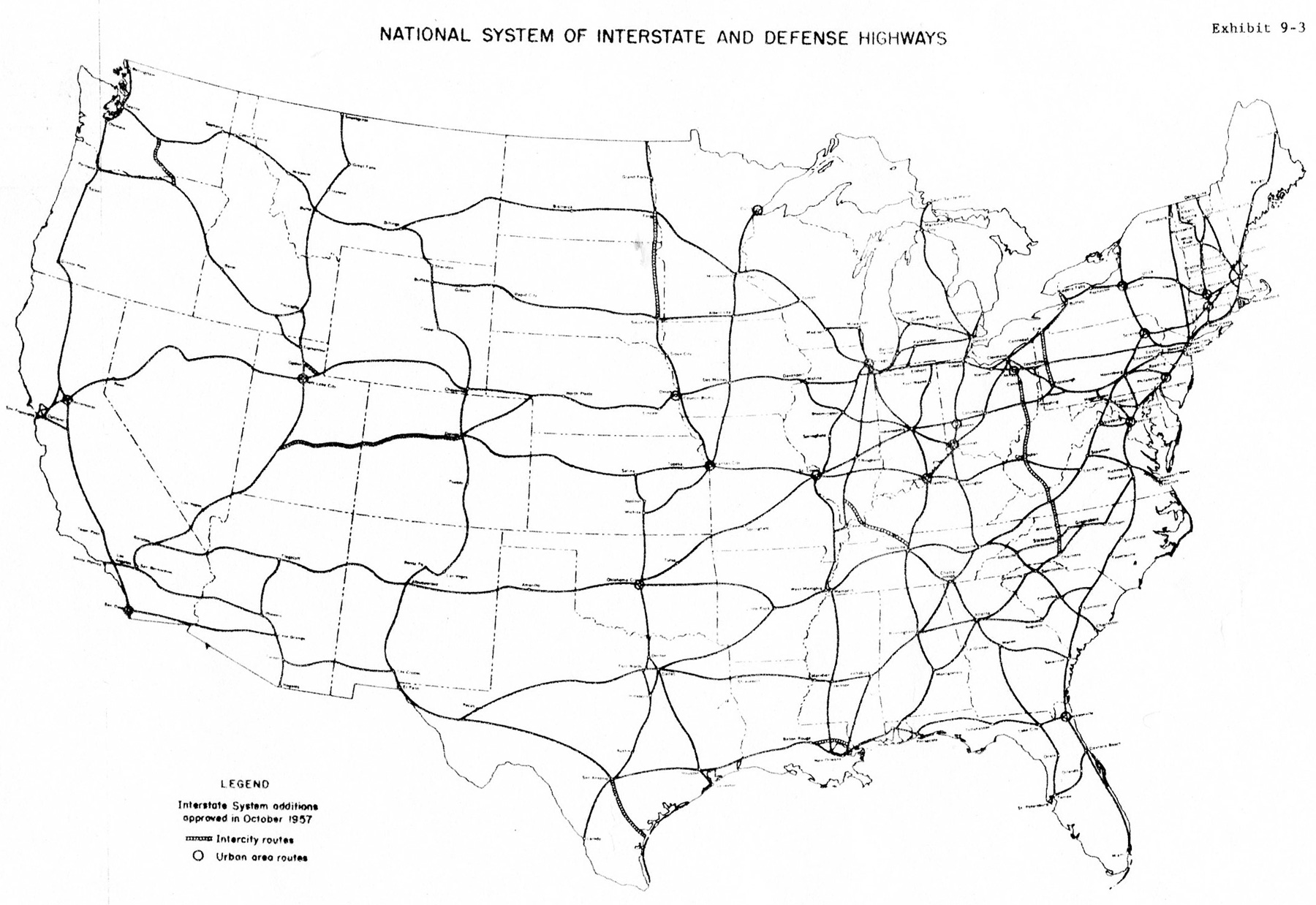
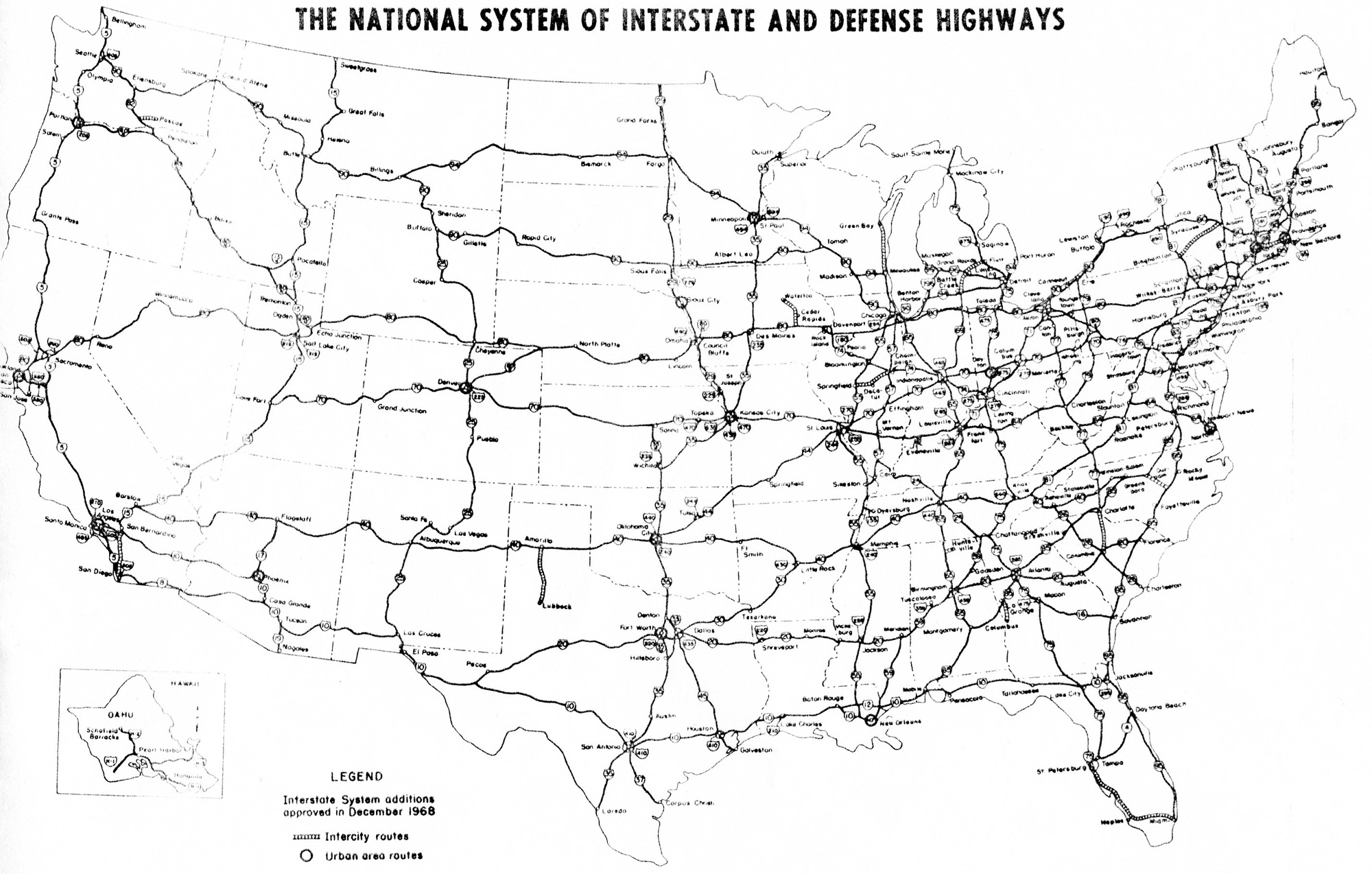
Loops
As originally envisioned, 3di-loops were to serve as bypass routes for cities, beltways or urban routes serving downtown areas. Beltways were built initially as through-route bypasses, but now mostly act to join the suburbs with the city center and otherwise serve as commuter routes.
Beltway examples include Interstate 275 around Cincinnati, Ohio and Interstate 495 around Washington, DC. Urban loops include Interstate 675 through Saginaw, Michigan and Interstate 235 through Des Moines, Iowa. Bypass routes include Interstate 495 around Wilmington, Delaware and Interstate 205 around Portland, Oregon.
Another exception to the even-numbered rule is Interstate 476, which was lengthened in 1996 from an outer bypass/commuter route west of Philadelphia into a long distance route joining Southeastern Pennsylvania with Scranton and the Poconos Region along the Northeast Extension of the Pennsylvania Turnpike.
Spurs
Three-digit Interstates fitting the category of spurs were to connect a city with a parent Interstate route, or to serve as a more direct route to an area in lieu of the main two-digit routes. Expansion of the Interstate system resulted in some exceptions to these basic rules, with extensions of Interstate 376 northward from Pittsburgh, Pennsylvania and Interstate 520 east to North Augusta, South Carolina extending former spurs into full loops.
Traditional spurs include Interstate 540 southwest to Fort Smith, Arkansas and Interstate 182 east to the Tri-Cities of Washington. Odd numbered 3-digit Interstates that function as a more direct route to the main 2-digit Interstates include Interstate 380 northwest from I-80 to I-84 in northeastern Pennsylvania and Interstate 135 north from Wichita to Salinas in Kansas. Both of those routes were originally given a suffixed designation however.
Suffixed Routes
Suffixed Interstate routes, Interstates ending with the letter E, N, S or W, expanded the function of a primary route as a cardinal-direction based branch. This allowed both Baltimore and Washington to both be served by Interstate 70 and Philadelphia to lie along the Interstate 80 corridor via Interstate 80S. AASHTO however determined in 1973 that suffixed based Interstates were to be renumbered to eliminate their use due to motorist confusion. All were changed by 1980 with the exception of the Interstate 35E/W separation through both Dallas-Fort Worth and Minneapolis-St. Paul, because neither city wanted to relinquish the parent route in lieu of a three-digit renumbering.
The act of Congress to designate the Interstate 69 corridor from the Lower Rio Grande Valley (LRGV) in South Texas northward to the preexisting Interstate 69 in Indianapolis included a provision for three new suffixed routes. They are Interstate 69W, serving Laredo, Texas to the west, Interstate 69C (C for Central Branch) serving the LRGV at McAllen to the south and Interstate 69E, running south to Corpus Christi and Brownsville near the Gulf of Mexico. Because these routes were written into law, they are exempt from the long standing AASHTO rule regarding suffixed routes.
Unsigned Routes
These routes are officially part of the Eisenhower Interstate System, yet are official essentially only on paper or internal documentation as no shields or other signage of their existence is posted. The routes otherwise adhere to Interstate standards and receive funding similarly to other fully posted routes.
Directions
- Even Numbers travel east-west (I-4, I-8, I-10, I-12, etc.)
- Odd Numbers travel north-south (I-5, I-15, I-17, I-19, etc.)
Significance
- Routes ending in "0" are major east-west routes (I-10, I-20, I-40, I-70, I-80, I-90)
- Routes ending in "5" are major north-south routes (I-5, I-15, I-25, I-35, I-55, I-65, I-75, I-85, I-95)
Orientation
- Lower numbered routes are generally located in the south and west
- Higher numbered routes are generally located in the north and east
- As a result, the Interstate Highway system forms a grid with numerical designations increasing gradually from low to high - both from west to east and south to north.
- Interstate Highways were numbered so that they would not conflict with the preexisting U.S. Numbered System; additionally the intent was that no Interstate Highway and U.S. Route would share the same number within the same state.
- I-24 and U.S. 24 currently both exist in Illinois.
- Plans for extensions to I-49, I-69, and I-74 will result in those routes meeting and intersecting their U.S. Highway counterparts.
- Some Interstate Highways are Unsigned, including a variety of spur and loop routes that are often superfluous or confusing designations in addition to the primary route number.
- Loop routes and through routes that generally connect to an Interstate highway at either end have an even first digit:
- Full 360-degree beltways include I-270 OH, I-275 KY/OH/IN, I-285 GA, I-410 TX, I-465 IN, I-495 MD/VA, I-610 TX, I-695 MD.
- I-275 in KY, IN, and OH is the only three-digit Interstate currently to serve three states.
- I-495 (Capital Beltway) serves Virginia and Maryland, but a portion of the route passes through the District of Columbia while crossing the Potomac River at the Woodrow Wilson Bridge.
- I-271 and I-480 merge together briefly east of Cleveland, marking the only location where two three-digit Interstate routes merge together.
- The following routes have an even first digit but do not end at another Interstate highway on one end: I-264 VA, I-295 NY, I-478 NY, I-495 NY, I-678 NY, I-635 TX, I-878 NY.
- The following routes are examples of intercity routes, acting in a regional capacity: I-280 CA, I-476 PA, I-495 MA, I-680 CA, I-684 NY/CT
- I-238 in CA acts as a spur of I-80, connecting I-880 and I-580 in the San Francisco Bay Area. At the time it was commissioned, no more I-x80 route numbers were available for use, so the designation of adjacent CA 238 was used to number I-238.
- Some even-prefixed three-digit routes serve states that are not served by their parents, including I-275 OH/KY/IN and I-287 NJ/NY.
- Spur routes and city routes that may or may not connect to an Interstate highway at one end have an odd first digit:
- I-585 in SC does not connect to its parent (I-85) currently; it begins at Business Loop I-85 and ends in Downtown Spartanburg.
- The following routes are examples of intercity routes, acting in a regional capacity: I-380 PA, I-385 SC, I-505 CA.
- Some odd-prefixed three-digit routes serve states that are not served by their parents, including I-129 NE/IA and I-535 MN/WI.
- Some Interstates have state route extensions, including I-15 in San Diego (continues as CA 15), I-265 in New Albany (continues as IN 265), I-381 in Bristol (continues as VA 381), I-481 in Syracuse (continues as NY 481), I-690 in Syracuse (continues as NY 690), and I-794 in Milwaukee (continues as WI 794/Lake Parkway).
- Some proposed future Interstate corridors have state route designations, or were previously numbered as such. Some examples include I-840 near Nashville and CA 905 in San Diego.
- Still other state routes have numbers that may make it look like a future Interstate corridor but are not, including VT 191 in Newport and IL 394 near Chicago Heights.
Incident Routes
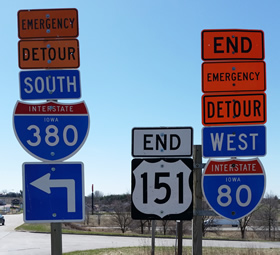
Another subsection of Interstate highways are Alternate, Detour, or Emergency routes. These are marked with trailblazers or on small sign panels with the standard Interstate shield posted below a banner stating its classification (which varies from state to state). They are commonly posted on other state-maintained facilities, rural highways or collector routes paralleling Interstate highways in Indiana, Michigan, Wisconsin and a handful of other states. The alternate routes may intersect one another.
These routes are used for incident management to redirect traffic during emergency or temporary road closures along the parent freeway. Various characteristics factor into what route is designated as an Emergency Interstate Route, such as roadway geometry vs. the primary route, locations of schools, community facilities and at-grade railroad crossings. Routes are usually marked with permanent signing, placed in advance or on the near side of an intersection, and after a turn made by the route. The MDOT guidelines specify placement at a density of approximately five miles between confirming assemblies.