
Interstate 9
Overview
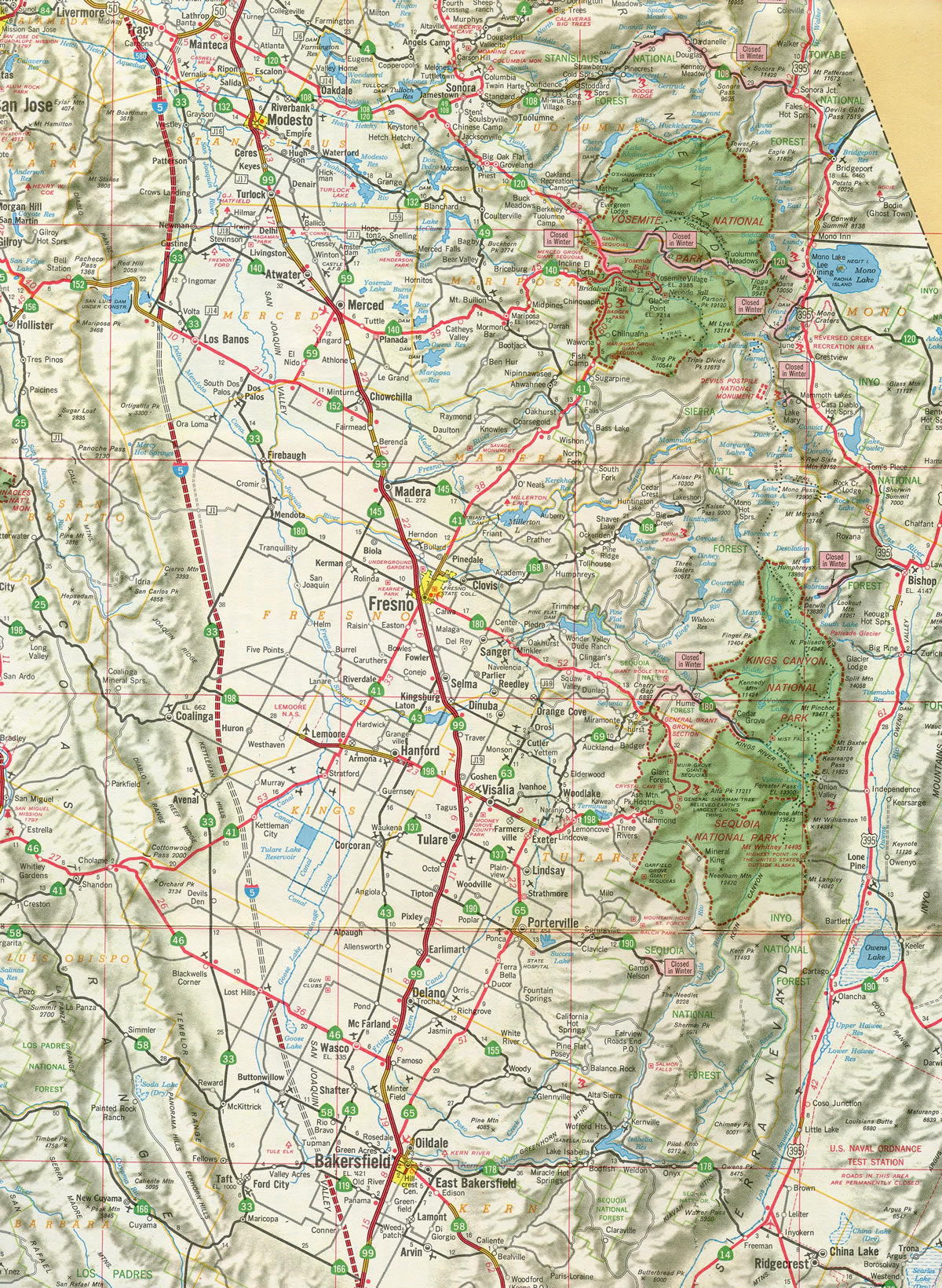
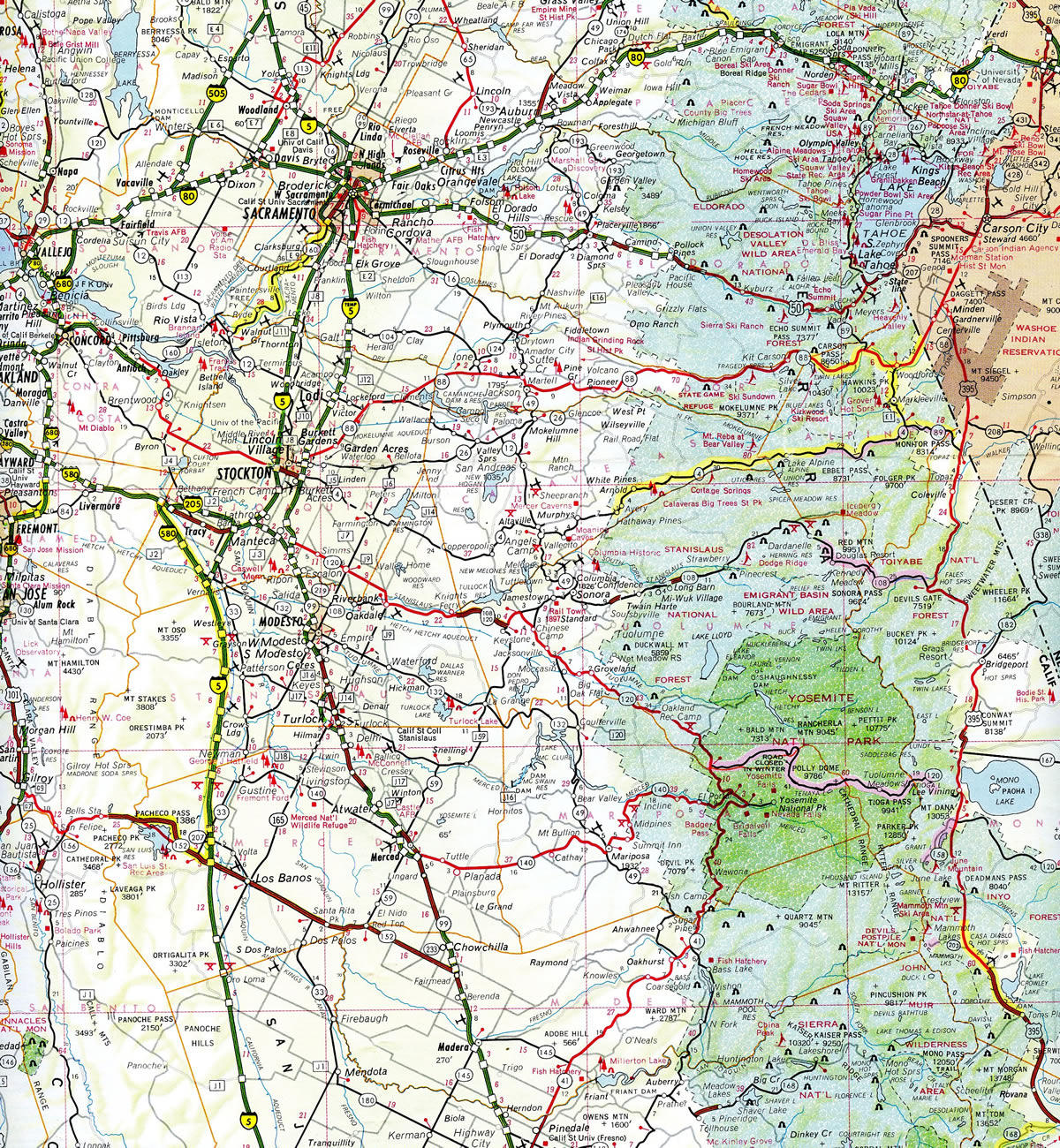
Interstate 9 is the designation proposed for the State Route 99 corridor between Mettler (near Wheeler Ridge) and Stockton in California.7 Upon entering Stockton, I-9 would turn west along SR 4/Crosstown Freeway to meet Interstate 5, its proposed northern terminus. The freeway along SR 99 between Stockton and Sacramento is not being considered for inclusion in the I-9 corridor, and will not be upgraded to Interstate standards.
SR 99, the Golden State Freeway, follows the original U.S. 99 corridor avoided by Interstate 5 through the Central Valley region. Converted in stages from the 1940s today from a two-lane farm road into today's four to eight lane freeway, the final at-grade intersections along SR 99 between Wheeler Ridge and Stockton were eliminated, creating a continuous freeway corridor through the Central Valley. With the removal of these at-grade intersections (completed with the interchanges between Chowchilla and Merced by 2016), the next step in the improvement of SR 99 is to bring it to full Interstate-standard freeway status. To that end, politicians in the Central Valley have crafted a resolution that would request adding SR 99 from Mettler to Sacramento into the Interstate Highway System.1,2
Interstate 7 was another potential designation being considered for the SR99 corridor. With the publication of the Route 99 Corridor Master Plan,7 the recommended designation for SR 99 was more likely to be Interstate 9. However, several other sources (including Wikipedia, The San Francisco Chronicle, and other media) reported that SR 99 might become I-7. However, none of these cited an official source confirming SR 99 will be Interstate 7. So, the Route 99 Corridor Master Plan is about as close to official as we have found that the new designation will be I-9.
Converting State Route 99 to Interstate 9
California State Route 99 has been considered for inclusion in the Interstate Highway System three times:7
- In the late 1950s, when the original Interstate System was designated.
- In the mid-1980s, when Interstate 5 was reconfirmed as the primary Interstate route through the Central Valley.
- In 2002, when Fresno-based Regional Jobs Initiative (RJI) petitioned to have California 99 granted Interstate status. RJI is "a grass roots group of business and economic interests with a common mission of creating 30,000 new medium paying jobs over a five year period."7
- The corridor must serve long distance interstate travel, connecting metropolitan areas and industrial centers that are important to defense and economic development.
- The route must secure final environmental approval and not duplicate other interstate routes.
- Routes must also directly serve major highway traffic generators and connect to the Interstate system at each end.
- The route must meet Interstate Highway standards, or a formal agreement must be reached between the state and federal government to construct the route to such standards within 12 years.
State Route 99 connects the major cities of the Central Valley, including Bakersfield, Visalia, Fresno, Merced, Madera, Modesto, Manteca, Stockton, Lodi, and Sacramento. All of these cities, excepting Stockton and Sacramento, are avoided by Interstate 5.
Due to the age of SR 99, the highway was built to Interstate standards in newer sections, but older sections retained several deficiencies requiring improvement according to Caltrans, including:3
- Lack of vertical clearance of bridge and overhead ramp structures
- Lack of shoulder width adjacent to the highway
- Insufficient median width
- Interchange, spacing and encroachment issues
A full list of the deficiencies were previously listed at the Caltrans Interstate 99 Designation Issues web site: http://www.dot.ca.gov/dist6/planning/inter99impact/ and potential interchange closures to address the spacing issues were outlined at http://www.dot.ca.gov/dist6/planning/inter99impact/closures.SM.pdf
According to the legislative analysis, "SCR 17 (Costa), Resolution Chapter 84, Statutes of 2001, requests the Department of Transportation (Caltrans) to report by January 1, 2002 to the Legislature on ways to improve traffic congestion and transport on SR 99 between Bakersfield and Sacramento. The report was completed and included several recommendations for improvements to SR 99. The report also identified $675 million worth of rehabilitation, operation and safety improvements that were necessary for the corridor." Not considered in this cost is the re-signing of SR 99 as Interstate 9.
In early 2004, Fresno Mayor Alan Autry and Fresno County Supervisor Bob Waterston brought the idea forward to make SR 99 into a toll road. The two officials planned for toll booths at either end of the route through the Central Valley (probably just north of the Grapevine and somewhere near Sacramento), and the tolls would provide funding for needed upgrades along SR 99. In a Fresno Bee article, Waterston commented about tolls: "When you bring this up to people, first of all there's a shock, and then it's 'Why not?' You know, they do it in Connecticut." 6 It is not clear whether this proposal was vetted through the Fresno County Council of Governments or with other regional planning agencies in the Central Valley. A toll road remains a possibility, but it is not at the forefront of possible solutions.
Mileage by State
| California | 254.00 mi |
Data Sources
estimate
Background / History
Much of this activity began in the city of Fresno, often referred to as the largest city in the country not served by an Interstate highway. Interstate 66, proposed in 1991 as a new cross-country Interstate corridor, was the first course of action for Fresno politicians to bring the city onto the Interstate Highway System. However, Interstate 66 would have traveled over the Sierra Nevada Mountains, perhaps via Kings Canyon and/or Sequoia National Parks to enter Fresno via California State Route 180. Environmental concerns seemed to outweigh the benefit of I-66, so the concept of this route gained little momentum in Fresno. By Fall 2004, I-66 was actively planned for construction in Kentucky but virtually nowhere else. However, Fresno politicians continued in their quest to bring Fresno into the Interstate Highway System by looking at other avenues, specifically, the freeway along SR 99.
On June 11, 2003, the "California Report" segment on KQED, San Francisco's National Public Radio station, indicated that there is a strong desire in Fresno to put the city onto the Interstate Highway System.4 Fresno is the largest city in the United States not served by a single Interstate Highway, and there is a sense of prestige that would be created by converting SR 99 into an Interstate. Although local politicians support such a new Interstate, there is a cost associated with converting the highway to Interstate standards and changing the signs. One of these politicians was Assemblyman Bill Maze, who brought the issue to the California legislature in July 2004.
At that time, Assemblyman Maze crafted Assembly Joint Resolution (AJR) 63, "Relative to State Highway Route 99," a measure that would memorialize the intent of the legislature of California (Assembly and Senate) to advise the President and Congress of the United States a request that they "enact legislation to include State Highway Route 99 in the Interstate Highway System." 1 The resolution was adopted by both houses of state government and filed with the California Secretary of State on August 19, 2004. Notably, the resolution requests either (1) the federal government exempts SR 99 from fulfilling Interstate standards or (2) the state of California is exempted from financing any costs to upgrade SR 99 to federal Interstate requirements.
In the resolution, Maze listed a variety of reasons why SR 99 ought to be incorporated into the Interstate Highway System:1
- The SR 99 corridor has the "largest urban area not in the Interstate highway system and Fresno is the largest city in the United States not served by an Interstate highway."
- The "omission of highways in the urban areas of the Central Valley from the interstate highway system cannot be justified and should be remedied."
- Economic development along the SR 99 corridor, pursuant to studies that have "long shown that economic development is enhanced in areas that are close to Interstate highways."
- The Central Valley one of the highest concentrations of unemployment in the United States, and upgrading the highway could enhance opportunities to promote employment and eliminate what has been a persistent problem in an agricultural region
- In a shot at Interstate 5, the resolution states "Interstate Highway 5 has been designated the NAFTA corridor, even though most of the trucks engaged in international trade and commerce travel on State Highway Route 99 ... [and] truck cargo volumes on State Highway Route 99 exceed those on Interstate Highway 5 and are among the highest in the entire nation, and this is the only segment of the federal highway system with this level of traffic not in the interstate highway system."
- An improved SR 99 corridor would bring environmental benefits, including the reduction of truck and auto congestion, which in turn would lead to the reduction of air pollution, which is a severe problem throughout the Central Valley.
- Vacationers and tourists to Yosemite, Sequoia, and Kings Canyon National Parks generally use SR 99 rather than Interstate 5 to reach their destinations even though "families prefer to travel to their destinations along Interstate highways that are known to be twice as safe as other highways, and tourism would be enhanced if State Highway Route 99 is upgraded to an interstate highway."
- Finally, the resolution indicates that the Central Valley is "the most rapidly growing part of California, and one of the most rapidly growing areas of the nation, and future demand will make all of the arguments for upgrading State Highway Route 99 even more urgent."
The effort to bring a second north to south Interstate to the Central Valley was almost derailed by State Senator Dean Florez, who considers California 99 a historic corridor that needs some preservation. Florez pulled AJR 63 from the consent agenda of the Senate, and it was initially denied in July 2004.2 Senator Florez and Assemblyman Maze negotiated, and they agreed to add the following language: "State Highway Route 99 is granted a historic designation of 'Historic Route 99.'" In addition, the two agreed to the language that supports an exemption to requirements that SR 99 meet Interstate standards.1
Notably, the SR 99 designation would almost certainly have to change. As noted in the legislative analysis of AJR 63, the Federal Highway Administration (FHWA) has a "formal policy for the signing and number of future interstate corridors. The number of future IHS routes must be coordinated with the states and approved by the American Association of State Highway and Transportation Officials and FHWA. The designation of 'Interstate 99' is currently being used by the state of Pennsylvania, which means that California more than likely would have to renumber SR 99."
On August 10, 2005, the SAFETEA-LU added California 99 from Interstate 5 south of Bakersfield north to Sacramento as High Priority Corridor 54.5 In addition, SAFETEA-LU designated California 99 officially as a future Interstate corridor, although it did not specify a numerical designation. SAFETEA-LU authorized a higher priority (yet unspecified amount) for funding general improvements to SR 99 since it is a future Interstate corridor, but the appropriations package included several specific earmarks for the route. It is unclear how this action will impact the state's plans for the route.
References
- Assembly Joint Resolution 63: Relative to State Highway Route 99 Retrieved from http://www.leginfo.ca.gov/pub/bill/asm/ ab_0051-0100/ajr_63_bill_20040819_chaptered.html
- Official Newsletter of Bill Maze Retrieved from http://republican.assembly.ca.gov/ enewsletters/b_index.asp?Dist=34&mem=130&news=1162
- Assembly Bill Analysis of AJR 63 Retrieved from http://www.leginfo.ca.gov/pub/bill/asm/ ab_0051-0100/ajr_63_cfa_20040716_163702_asm_floor.html
- KQED, San Francisco's National Public Radio station.
- "Nunes discusses Highway 99." Visalia Times-Daily Local News, July 16, 2004.
- "Officials propose a Highway 99 toll road." The Fresno Bee, February 1, 2004.
- Final Draft - Route 99 Corridor Enhancement Master Plan. Retrieved from http://www.dot.ca.gov/dist6/99masterplan/docs/finalDraft.pdf
- Interstate 2000: Improvement for the Next Millenium. (June 1997). Roads and Bridges.