

Interstate 530 Arkansas

Overview
Interstate 530 connects Little Rock with Pine Bluff along a 35 mile long course south along the Arkansas River valley. The rural freeway is also U.S. 65, but Arkansas Department of Transportation (ArDOT) signing practices omit the overlap.
Plans call for eventual extension of I-530 south to the future Interstate 69 corridor at Monticello. Two sections of the future route are completed. Arkansas State Highway 530 spurs 23.6 miles south from the Pine Bluff Bypass to Highway 11 southwest of Star City. Measuring 4.5 miles, the southern segment of Highway 530 links Highway 35 with U.S. 278 west of Monticello. Both segments of Highway 530 travel at-grade with two lanes.
High Priority Corridor
The proposed extension of Interstate 530 from Pine Bluff south to Monticello (Interstate 69) is part of High Priority Corridor 18: NAFTA Superhighway (Section (18)(C)(ii)).
 History
 History
The northern ten miles of I-530 predate 1970. Interstate 530 was approved by the American Association of State Highway and Transportation Officials (AASHTO) on November 14, 1997, as a future route between U.S. 65 south of Pine Bluff and I-30 south of Little Rock. Interstate 530 was commissioned August 2, 1999 over the preexisting freeway along U.S. 65 on the same day that the western portion of the Pine Bluff bypass opened to traffic.
Route Information
North End – Little Rock, AR
South End – Pine Bluff, AR
Mileage – 46.54
Cities – Little Rock, Pine Bluff
- Junctions –


I-530 Annual Average Daily Traffic (AADT)
I-530 Extension
Interstate 530 is a direct result of the “Dickey Split” compromise, which proposed access to the Interstate 69 / NAFTA corridor from Pine Bluff.1 The southern extension of I-530 parallels U.S. 425 to the west from Star City to Monticello. Originating in Pine Bluff, U.S. 425 was commissioned in 1989. The interim designation is Arkansas Highway 530.
Initial sections of the I-530 corridor south from Pine Bluff were to be built as at-grade expressways with two lanes.1 The first section of AR 530 opened between U.S. 278 and AR 35 near the city of Wilmar on June 6, 2006.2
The I-530 Extension south to the future I-69 corridor in southeastern Arkansas was estimated to cost at least $300 million in 2003. Construction of the 38 mile long route was projected to begin at both at Pine Bluff and Monticello. Early funding for I-530 diverted money from a $30 million widening project for nearby U.S. 425 for construction along I-530, U.S. 65 and U.S. 167.3 Another $84 million from a $100 million appropriation from Congress was assigned to an area near Pinebergen for a four lane segment of highway.1
The Arkansas Highway and Transportation Department (AHTD), predecessor to ArDOT, projected as many as 8,600 vehicles per day (vpd) along the 4.5 mile section of Highway 530 in Drew County. Traffic counts further north were projected between 26,100 to 32,600 vpd once the highway reached Pine Bluff.3 Costs were estimated at $620 million to complete the three remaining sections of I-530 between U.S. 278 and Pine Bluff in 2008.4
Further lengthening of Interstate 530 beyond Monticello was promoted as part of the campaign for John “Jock” Scott, a Republican candidate for the fifth district of the U.S. Congress in Louisiana in the 2004 election. Promoting the potential for economic growth, Scott made extending I-530 south from Arkansas to Monroe and Alexandria one of the fundamental tenets of his campaign.5
During the elections of November 2, 2004, Jock Scott was soundly defeated at the polls, carrying only 16% of the vote. Incumbent Representative Rodney Alexander won with 59% of the vote.
 Photo Guides
 Photo Guides
North End 

 – Little Rock, Arkansas


 North at


I-530/U.S. 65-167 cross Granite Mountain ahead of the exchange with I-30 and I-440 in south Little Rock. 05/20/14
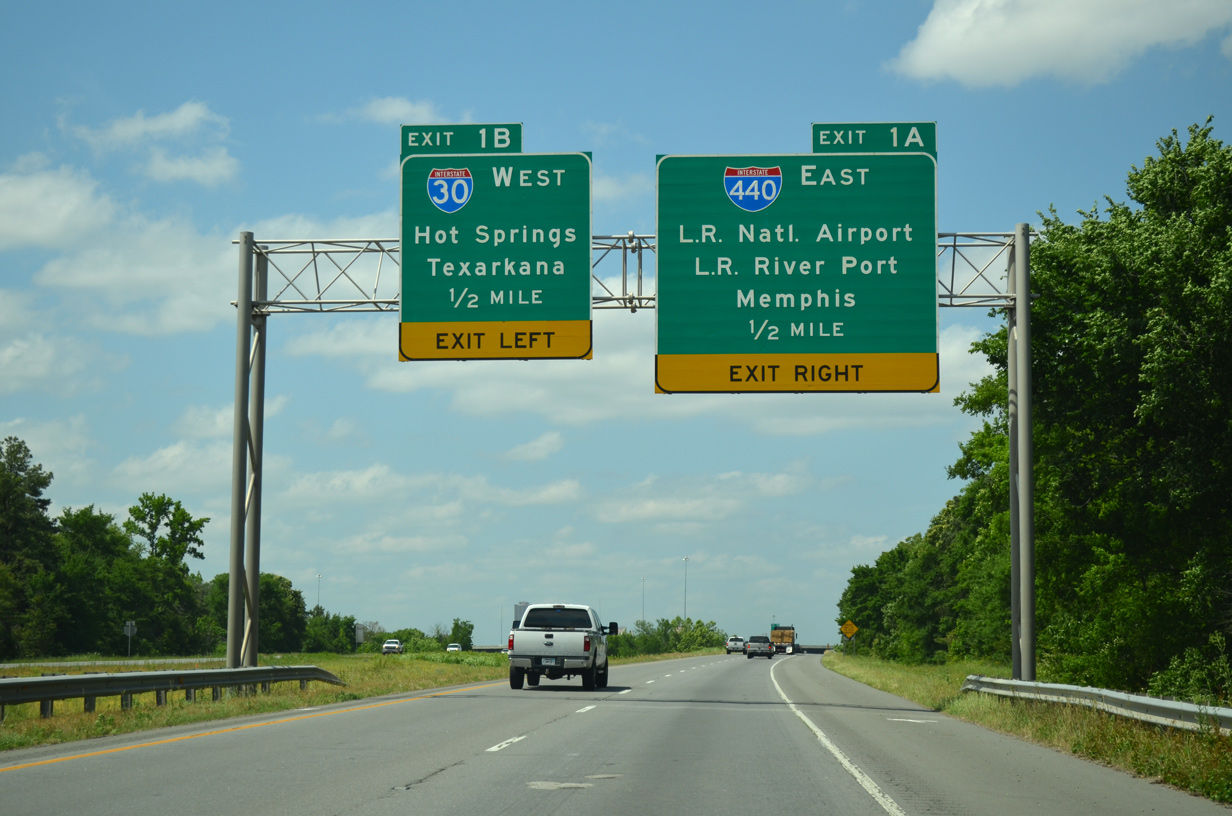
Ramps for I-30 west to Hot Springs and I-440 east to Bill and Hillary Clinton National Airport (LIT) separate from the north end of Interstate 530 nearly simultaneously in one half mile. 05/20/14

Left Exit 1B departs from Intestate 530 beyond Fourche Creek, a tributary of the Arkansas River. I-30 travels west another 12 miles across the city of Little Rock to the Saline County line at Exit 126. 05/20/14

Interstate 30 comprises a trucking corridor and regional freeway joining Little Rock with Texarkana and Dallas-Forth, Texas. 05/20/14

Interstate 440 stems east from the northward turn of I-30 into Little Rock along the Eastbelt Freeway to College Station, the Port of Little Rock and I-40/Highway 440 at North Little Rock. 05/20/14
West South at

Interstate 30 heads south from I-630 and Downtown Little Rock and meets I-440 east and I-530 south 1.25 miles beyond Exit 139A for Highway 365. 05/07/12

Continuing south over a Union Pacific Railroad yard, I-30 approaches the split with U.S. 65/167 at Interstate 530 (Exit 138). 05/07/12

Interstate 30 turns west and merges with traffic from the end of I-440 toward south Little Rock and Mabelville. I-440 arcs northeast to LIT Airport and I-40/Highway 440 in North Little Rock. 05/07/12
East North at

I-30 curves northeast through the multi level interchange with I-440 east and I-530/U.S. 67-167 south toward Downtown Little Rock. I-440 bypasses the city east to LIT Airport and I-40 at North Little Rock.
U.S. 65/167 combine with I-530 south to Exit 138B in Saline County. U.S. 167 branches southwest from there to Sheridan while U.S. 65 remains along I-530 to Pine Bluff. 05/07/12
West at

Interstate 440 westbound concludes beyond the left exit for I-530/U.S. 65=167 south to Sweet Home and Pine Bluff. 05/20/14
South End  – Pine Bluff, Arkansas
South 
 North at


I-530/U.S. 65 south and U.S. 63-79 north angle northeast from the directional T interchange with AR 530 to Exit 46 with AR 190 west, U.S. 65 Business north and U.S. 425 south. 05/07/12

A flyover separates at Exit 46 for the continuation of U.S. 63/79 north to the Arkansas County seat of Stuttgart. The I-530 mainline turns eastward along U.S. 65 and U.S. 425 toward Dumas and McGehee. 05/07/12

Exit 46 partitions with a left side ramp to Highway 190 west along Harding Avenue. U.S. 65 Business combines with U.S. 63/79 northward for a half mile. 05/07/12
North at
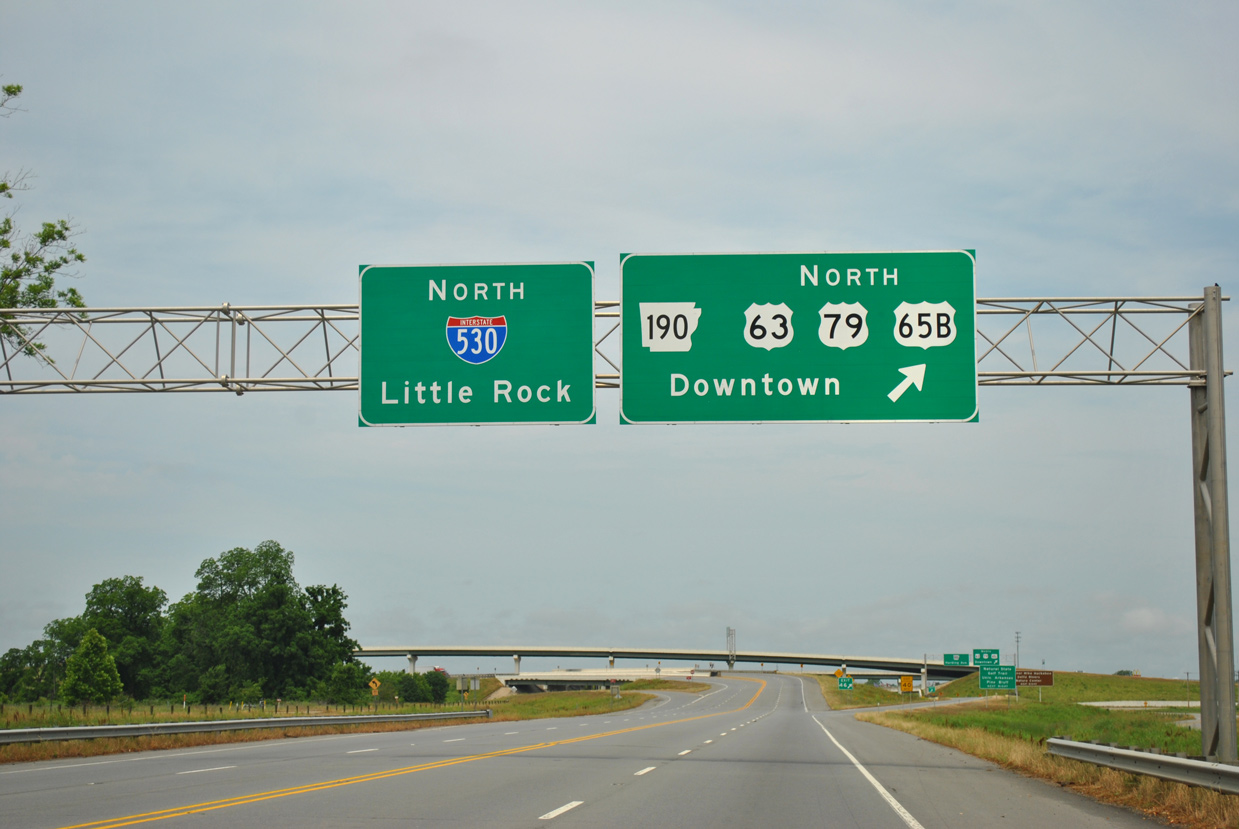
U.S. 65 north transitions into Interstate 530 at the multi level interchange with U.S. 63/79/65B north and AR 190 (Harding Avenue) west. Northbound U.S. 425 ends here. 05/07/12
South at

U.S. 63 was extended southward to Bastrop, Louisiana in late 1999. Overlapping with U.S. 79 from Stuggart, U.S. 63 combines with I-530/U.S. 65 north to bypass Pine Bluff en route to Warren. 05/07/12
East at

AR 190 navigates through the Pine Bluff street grid, connecting Downtown with the commercial strip along Harding Avenue. The state highway connects with Interstate 530 north and ends at U.S. 65 south. 05/07/12
Sources:
- Interstate 69 from Shreveport to Memphis, i69info.com (Chris Lawrence).
- “New Arkansas Highway to be dedicated.” KTHV (Little Rock, AR), June 5, 2006.
- “Panel reaches deal to build I-69 stretch from both ends.” Arkansas Democrat-Gazette (Little Rock), January 9, 2003
- “PB En Route to Having New Road.” Pine Bluff Commercial (AR), July 18, 2008.
- “Scott: Interstate will help economy.” Monroe News-Star (LA), October 21, 2004.
Page updated September 25, 2020.