

Interstate 505 Oregon

 Overview
 Overview
Interstate 505, the Industrial Freeway, was a planned 3.17 mile long spur from I-405 along the U.S. 30 corridor in northwest Portland. The Industrial Freeway was conceptualized as early as 1959 and 1963. The American Association of State Highway Officials (AASHO) approved the I-505 designation on June 23, 1969 and the Interstate highway was proposed in 1971 as a 1.3 mile long facility. Controversy involving the construction of I-505 ensued. A lawsuit demanding an environmental study was presented to the U.S. District Court in 1971, and it was debated through the rest of the decade.
Interstate 505 was formally withdrawn from Oregon’s Interstate Highway System in December 1979. The lone segment built was the approach ramps to Interstate 405 and the Fremont Bridge at the east end. These were incorporated into a reroute of U.S. 30.1

Plans for Interstate 505 called for the west end to be at the St. Johns Bridge approach (U.S. 30 Bypass). This landmark bridge, built in 1931, would possibly have had its western approach modified to meet the proposed Interstate highway. 09/02/06
Route Information
East End – Portland, OR
West End – Portland, OR
Mileage – 3.17
Cities – Portland
- Junctions –

ODOT Hwy #92 / Lower Columbia River Hwy (US 30) Annual Average Daily Traffic (AADT)
| Milepost | Vehicles per day |
|---|---|
| 1.45 | 77,200 |
| 1.87 | 39,900 |
| 2.38 | 35,200 |
| 2.63 | 35,000 |
| 3.07 | 32,900 |
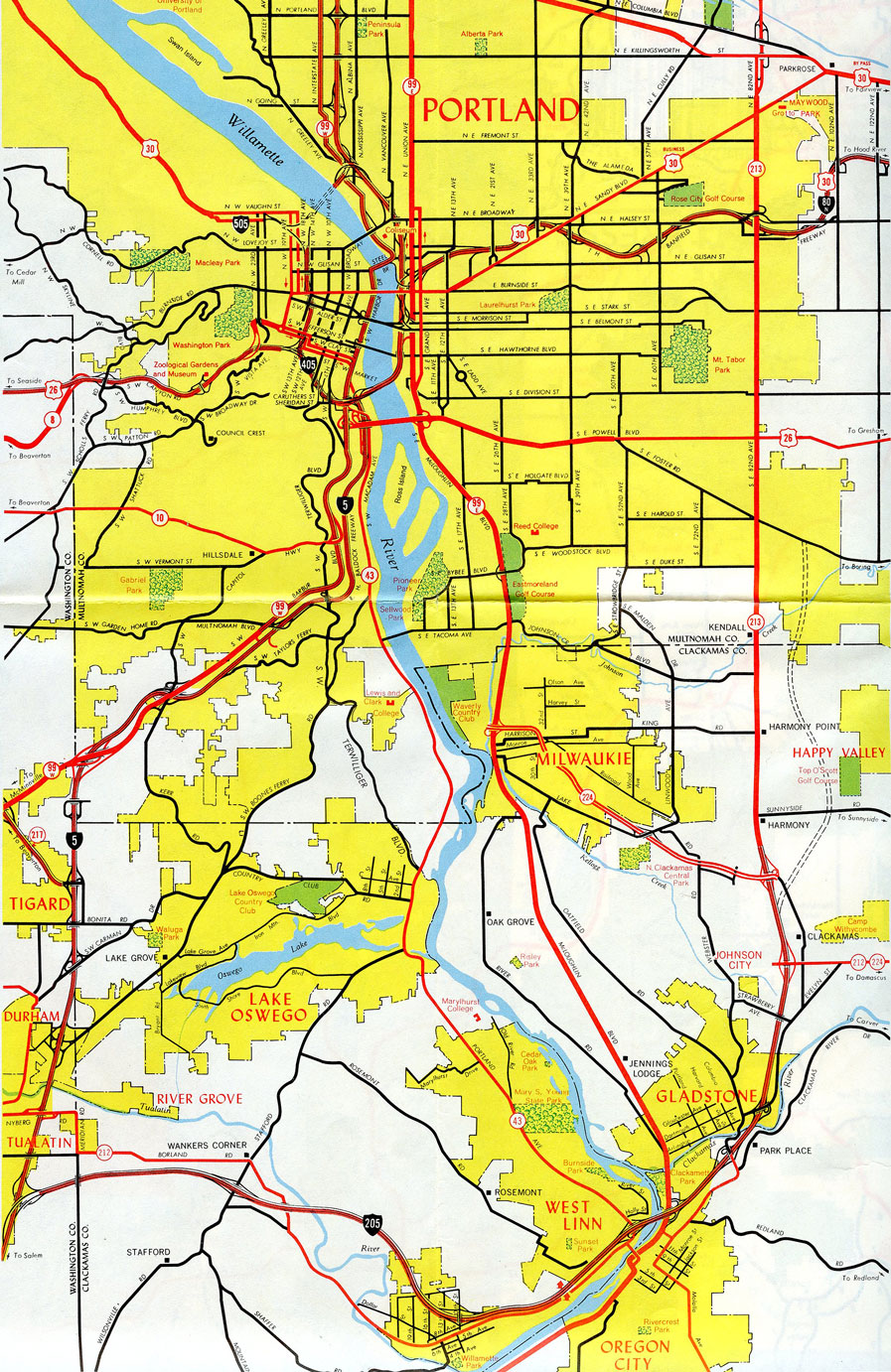
Interstate 505 appeared on the Portland inset of the 1973 Oregon Official Highway Map
According to Interstate 50th Anniversary: The Story of Oregon’s Interstates, the Interstate 505 freeway spur was planned to open up the industrial areas along Yeon Avenue; the freeway would have been routed on or along this section of U.S. 30. It would have extended from Interstate 405 in Downtown Portland to U.S. 30 Bypass where U.S. 30 changes into St. Helens Road. The course would have traveled through a considerable number of residential buildings and along the fringe of Forest Park. These factors ultimately caused Interstate 505 to join in Oregon’s Great Freeway Kill Off in the mid 1970s.2
The state of Oregon redirected federal Interstate dollars allocated for I-505 for an array of projects. These included funds for completing Interstate 205, Portland area highway improvements on U.S. 26 (Sunset Highway), Oregon 212, and Oregon 217 and other roads, and construction of mass transportation systems including the “Banfield Transitway Project”.
East End 
 / Fremont Bridge – Portland, Oregon
 East at

Eastbound U.S. 30 reaches N.W. Yeon Avenue near Forest Park; the US route shifts onto a brief freeway alignment that was to be a part of Interstate 505 until that freeway was eliminated in the Oregon Freeway Purge. Photo by Chris Elbert (05/28/05).

The short freeway proceeds one half mile to the exchange with Interstate 405. 07/20/23

The freeway along U.S. 30 continues from Vaughn Street to I-405 (Stadium Freeway). U.S. 30 eastbound transitions onto Interstate 405 north ahead. 07/20/23

Interstate 405 south links with U.S. 26 west as well as I-5 south to Eugene. 07/20/23

Taking the ramp from U.S. 30 east to Interstate 405 south in Portland. Photo by Chris Elbert (05/28/05).
North at

Northbound I-405 reaches Exit 2B to Everett Street. The succeeding exit is for U.S. 30, which would have been Interstate 505 had the rest of the freeway been built to the west. 08/27/06

A series of overpasses span Interstate 405 as the freeway passes just west of Downtown Portland. Exit 3 departs next from the left lanes to U.S. 30 westbound. 08/27/06

U.S. 30 branches northwest from I-405 to Yeon Avenue, past Forest Park, and on to St. Helens Road. 08/27/06

Interstate 405 transitions to the lower deck of the tied arch Fremont Bridge over the Willamette River beyond the separation with Exit 3 to U.S. 30 west at the planned I-505 freeway. 08/27/06

U.S. 30 extends northwest from Portland to Astoria on the Pacific Coast, where the transcontinental highway ends at U.S. 101 near the mouth of the Columbia River. 08/27/06
South West

I-405/U.S. 30 travel on the upper deck of the Fremont Bridge across the Willamette west from Interstate 5 to their split at Exit 3. U.S. 30 leaves the Portland urban loop via a short freeway spur that was to be part of planned I-505. 09/02/06
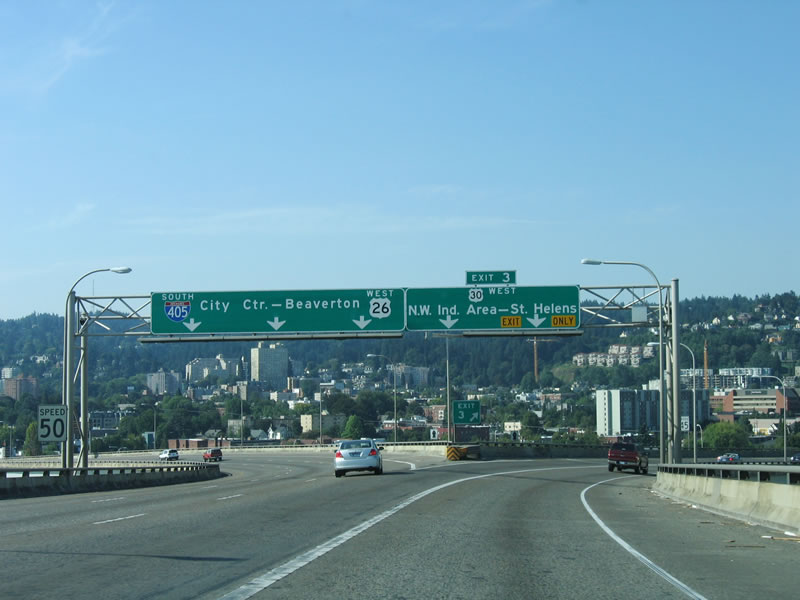
The Fremont Bridge is the largest tied arch bridge on the Interstate Highway System, with a much higher span than comparable bridges elsewhere in the system. The I-405/U.S. 30 split is at the south end of the main span. 09/02/06
West End of Freeway Spur (N.W. Yeon Ave) at Vaughn St – Portland, Oregon
West

The freeway spur of U.S. 30 travels a half mile northwest from Interstate 405 (Stadium Freeway) to Vaughn Street. 09/02/06

Traffic from Interstate 405 northbound joins U.S. 30 west ahead of the wye interchange with Vaughn Street. Vaughn Street represents the original U.S. 30 alignment to N.W. St. Helens Road. 09/02/06

U.S. 30 transitions into N.W. Yeon Avenue at forthcoming Nicolai Street. Prior to the completion of the Interstate 505 freeway ramps, U.S. 30 lined Vaughn Street just south of the Montgomery Park building. A former Montgomery Ward Distribution Center built in 1921, Montgomery Park today is an office building renovated in 1989. Montgomery Park is the second office building by volume in Portland.4 09/02/06
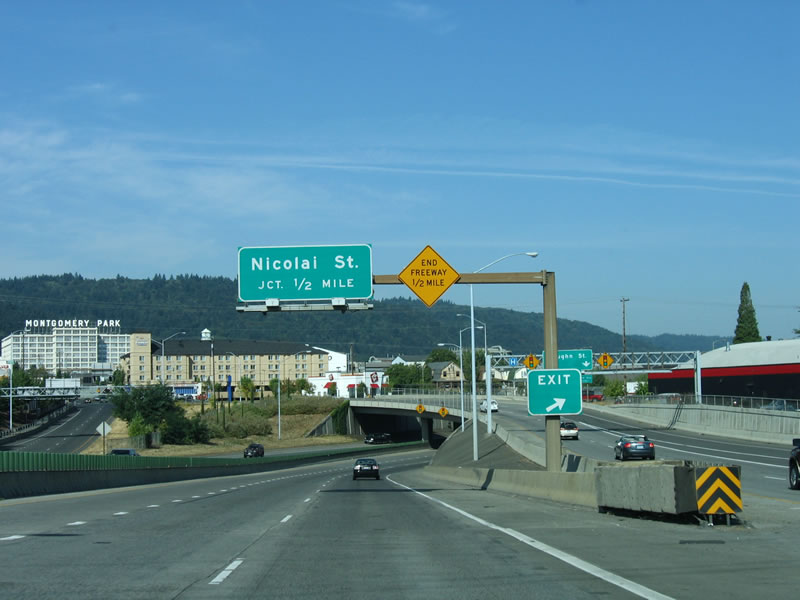

The U.S. 30 freeway proceeds another half mile beyond the Vaughn Street off-ramp to Nicolai Street. 09/02/06

U.S. 30 continues with two lanes beyond Nicolai Street to the N.W. Industrial Area, the St. Johns Bridge, and St. Helens via Yeon Avenue. 09/02/06

Following the Willamette River northwest toward St. Helens, U.S. 30 (Yeon Avenue) turns northwest through industrial and port areas. Interstate 505 would have extended along U.S. 30 from Nicolai Street into the N.W. Industrial Area. 09/02/06
East

U.S. 30 transitions into the freeway built for Interstate 505 in a quarter mile at the intersection with Nicolai Street. 09/02/06

Both lanes of Yeon Avenue transition onto the I-505 freeway spur as U.S. 30 shifts southward across Nicolai Street. 09/02/06
Nicolai Street at

A guide sign directs motorists from Nicolai Street eastbound onto the freeway spur linking U.S. 30 (NW Yeon Avenue) with Interstate 405. 09/02/06

Westbound Nicolai Street intersects U.S. 30 at N.W. Yeon Avenue and the short freeway spur from the Fremont Bridge. The proposed Industrial Freeway (Interstate 505) would have extended northwest toward the St. Johns Bridge from here. 09/02/06
Planned West End (N.W. Yeon Ave) at  / St. Johns Bridge – Portland, Oregon
West at  / St. Johns Bridge

4.6 miles north of the freeway end at Nicolai Street in the N.W. Industrial Area, westbound U.S. 30 approaches U.S. 30 Bypass and the St. Johns Bridge. This is where Interstate 505 would have ended. 09/02/06

The St. Johns Bridge comes into view beyond the left turn connecting U.S. 30 with NW Bridge Avenue to the suspension bridge. U.S. 30 Bypass is not signed in this direction. 09/02/06
/ St. Johns Bridge – West at

Crossing the St. Johns Bridge along U.S. 30 Bypass, the junction with I-505 would have been located at the south end of the span. Instead, the bridge connects with U.S. 30 near Forest Park. Designed by David B. Steinman, the green paint scheme of the St. Johns Bridge to promote harmony with the forest covered hills on the southern bank of the Willamette River.3 09/02/06

Located south of the confluence with the Columbia River, the St. Johns Bridge is the northernmost crossing over the Willamette River. Built in 1931, the St. Johns Bridge deck was rehabilitated in 2005. With a main span of 1,207 feet, the bridge rises 205 feet above the navigable waters below. The St. Johns Bridge is one of three major suspension bridges in the state of Oregon, none of which are on the Interstate Highway System.3 09/02/06

The north end of the undivided four lane St. Johns Bridge (U.S. 30 Bypass) ties into NW Bridge Avenue above U.S. 30 (NW St. Helens Road). 09/02/06
East at / St. Johns Bridge

Interstate 505 would originated from U.S. 30 near or at the junction with U.S. 30 Bypass (St. Johns Bridge). The first advance sign for the St. Johns Bridge along NW St. Helens Road south appears a half mile out. 09/02/06

U.S. 30 Bypass separates from U.S. 30 (NW St. Helens Road) via NW Bridge Avenue. U.S. 30 remains along St. Helens Road southeast to Yeon Avenue into the Northwest Industrial Area while U.S. 30 Bypass crosses the St. Johns Bridge to Germantown Road. 09/02/06
Sources:
- Interstate 50th Anniversary: The Story of Oregon’s Interstates.
- Chris Elbert, email: “Re: NW Interstate Updates at Interstate-guide.com.” March 16, 2005.
http://egov.oregon.gov/ODOT/HWY/GEOENVIRONMENTAL/docs/Historic_Bridge/Willamette_StJohns_Bridge.doc.http://www.billnaito.com/pages/montgomery.html.
Page updated February 1, 2024.