
Interstate 495 New York

Overview

Interstate 495 in New York is the Long Island Expressway, or the L.I.E. to locals. Per the Official Description of Highway Touring Routes, etc. in New York State,1 I-495 is a split route from the Queens-Midtown Tunnel to I-278 (Brooklyn Queens Expressway [BQE]) and from I-678 (Van Wyck Expressway) east to New York Route 25 at Riverhead. The portion of the LIE in between is referenced as New York Route 495.
The Long Island Expressway between the BQE and Van Wyck Expressway was constructed with six overall lanes without Interstate Construction (IC) funding. It was added to the Interstate System in September 1955. Additional lanes were approved for the route by the Federal Highway Administration (FHWA) in 1963. This outlined a ten lane concept, with four elevated lanes above the six lane mainline as adopted in the 1968 Interstate Cost Estimate.2
Governor Hugh L. Carey and Mayor Edward I. Koch jointly requested the withdrawal of a 4.7 mile long section of the LIE from the Interstate System on January 4, 1979 based on the additional elevated lanes. Secretary Brock Adams approved the withdrawal on June 29, 1979, reducing the unobligated balance of IC funds of New York by $14.5 million.1
Despite the official mileage for Interstate 495 not including the portion of the LIE between the BQE and Van Wyck, I-495 is fully signed along the entire length of the Long Island Expressway.
Mileage by State
| New York | 66.45 mi |
Data Sources
December 31, 2025 Interstate Route Log and Finders List
History
When first proposed in New York, Interstate 495 extended east from the Lincoln Tunnel across the Hudson River into Midtown Manhattan in New York City. Following the planned Mid Manhattan Expressway, I-495 was to connect with the Queens-Midtown Tunnel and continue east along the Queens Midtown Expressway and Horace Harding Expressway to the Clearview Expressway (I-78) in Queens, New York. I-495 would then turn northward along the Clearview Expressway and over the Throgs Neck Bridge. I-495 would split into branches along the Throgs Neck Expressway north to I-95 (New England Thruway) and the Cross Bronx Expressway Extension west to I-95 (Cross Bronx Expressway) at the exchange with I-278 (Bruckner Expressway) and I-595 (Hutchinson River Expressway.
I-495 was part of the urban Interstate numerology for New York submitted approved by the American Association of State Highway Officials (AASHO) on November 10, 1958. The New Jersey State Highway Department previously submitted I-195 as the designation for the route leading east to the Lincoln Tunnel before concurring with the AASHO recommendation for a continuous I-495. The State of New York reviewed changes made by the AASHO route numbering and amended Interstate 78 to replace I-495 northward from the Horace Harding Expressway. AASHO concurred with this change on February 5, 1959.
A controversial roadway, the Mid Manhattan Expressway was never built, leaving I-495 as a discontinuous route between Union City, New Jersey and Queens, New York. The I-495 designation was deleted west of I-278 (Brooklyn Queens Expressway) to the Lincoln Tunnel by the AASHO U.S. Route Numbering Subcommittee on June 23, 1969.
The last section of I-495 opened to traffic was the segment between Exit 71 (eastern NY 24) and Exit 73. Finished in the early 1970s, construction took about 15 years to complete. Prior to 1983, the Long Island Expressway east of Exit 27 (Clearview Expressway) was signed as New York State Route 495. The New York Congressional legislation led by Senator Alfonse D'Amato (R-NY) passed legislation at that time extending Interstate 495 east from the interchange with I-295 (Clearview Expressway) to the end of the expressway at Riverhead.
The New York State Department of Transportation (NYSDOT) requested the addition of the Long Island Expressway from I-295 (Clearview Expressway) at Exit 27 to Exit 71 at Calverton in Suffolk County to the Federal Highway Administration (FHWA) under the provisions of 23 U.S.C. 139(a). The FHWA concurred that it was a logical addition to the Interstate System in a letter to NYSDOT on October 25, 1983, further adding that the eastern terminus of I-495 should be at Exit 73 / NY 25. The revised route description was:
From the New York-New Jersey State line to the West Side Expressway (I-478) in Manhattan; from the east side of Manhattan, easterly via the Queens-Midtown Tunnel to the Brooklyn-Queens Expressway (I-295); and from I-678 (Van Wyck Expressway), easterly to State Route 25 at Exit 73.
The American Association of State Highway and Transportation Officials (AASHTO) approved the extension on May 24, 1984.


The New Jersey Department of Transportation previously received approval from the FHWA to eliminate I-495 from I-95 to Pleasant and Park Avenue at Weehawken Township in 1979. When I-478 along Westway was withdrawn from the Interstate System, it isolated the short segment of I-495 through the Lincoln Tunnel from the rest of the Interstate System. Actions by the FHWA removing I-478 also deleted all of I-495 west from I-478 under the provisions of 23 U.S.C. 103(f). The application formally eliminating I-495 from the West Side Expressway (I-478) west to the New Jersey state line was approved by AASHTO on June 10, 1986.
There was also occasional discussion of extending the Long Island Expressway along the North Fork of Long Island, and possibly even across Long Island Sound to New London, Connecticut, or Watch Hill, Rhode Island. Proving to be very controversial, those efforts to plan and construct such a link failed to gain traction due to local efforts to preserve the rural character of Long Island's East End.
East End  ‐ Riverhead, NY
 East at
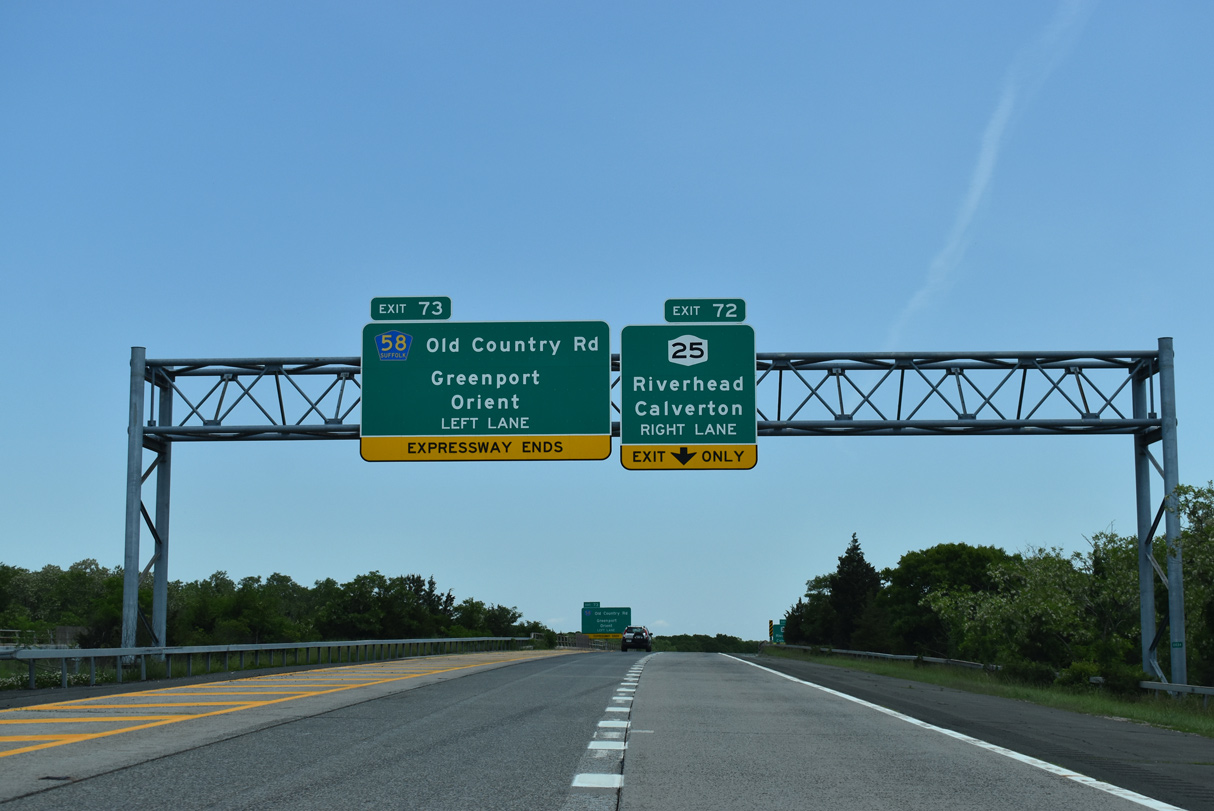
The final two exits along Interstate 495 east connect with NY 25 and CR 58 (Old Country Road). NY 25 leads four miles east to the Riverhead town center. 05/30/22


West at
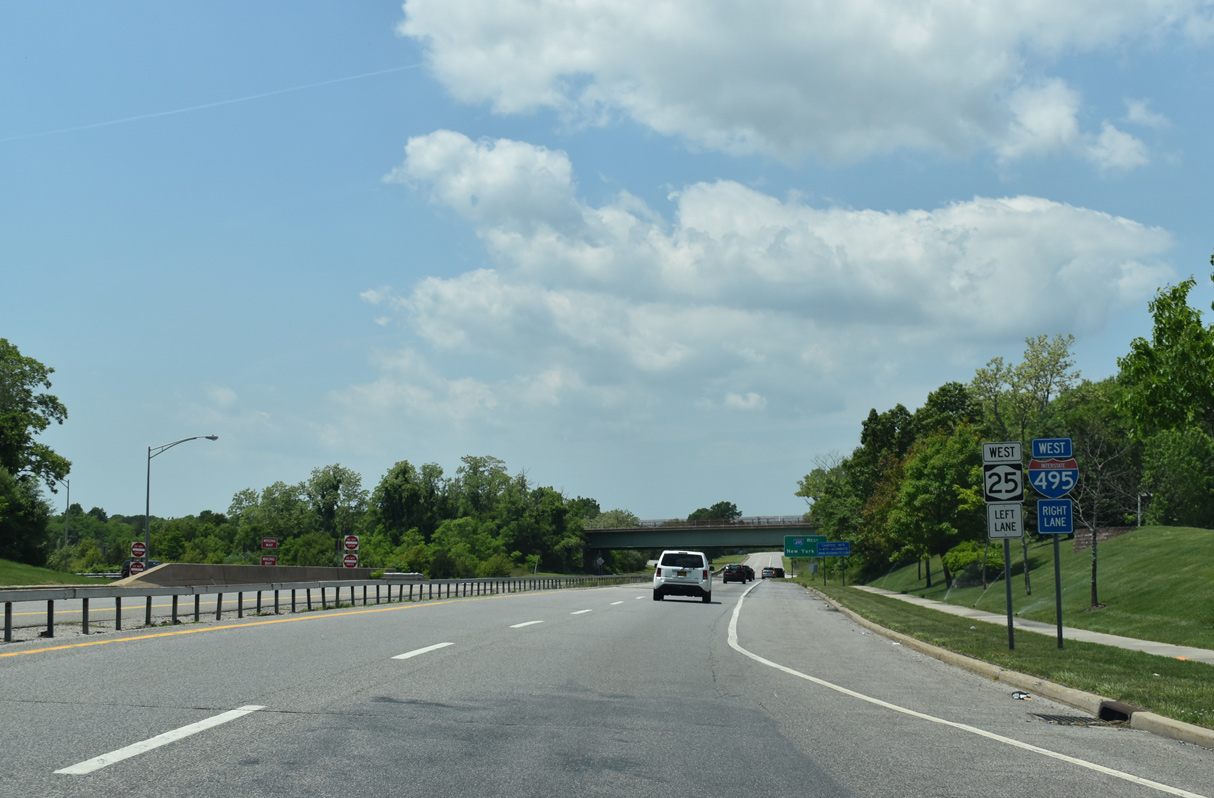
CR 58 (Old Country Road) converges with NY 25 (River Road) at a wye interchange just west of Interstate 495 en route to Calverton. 05/30/22

 East at
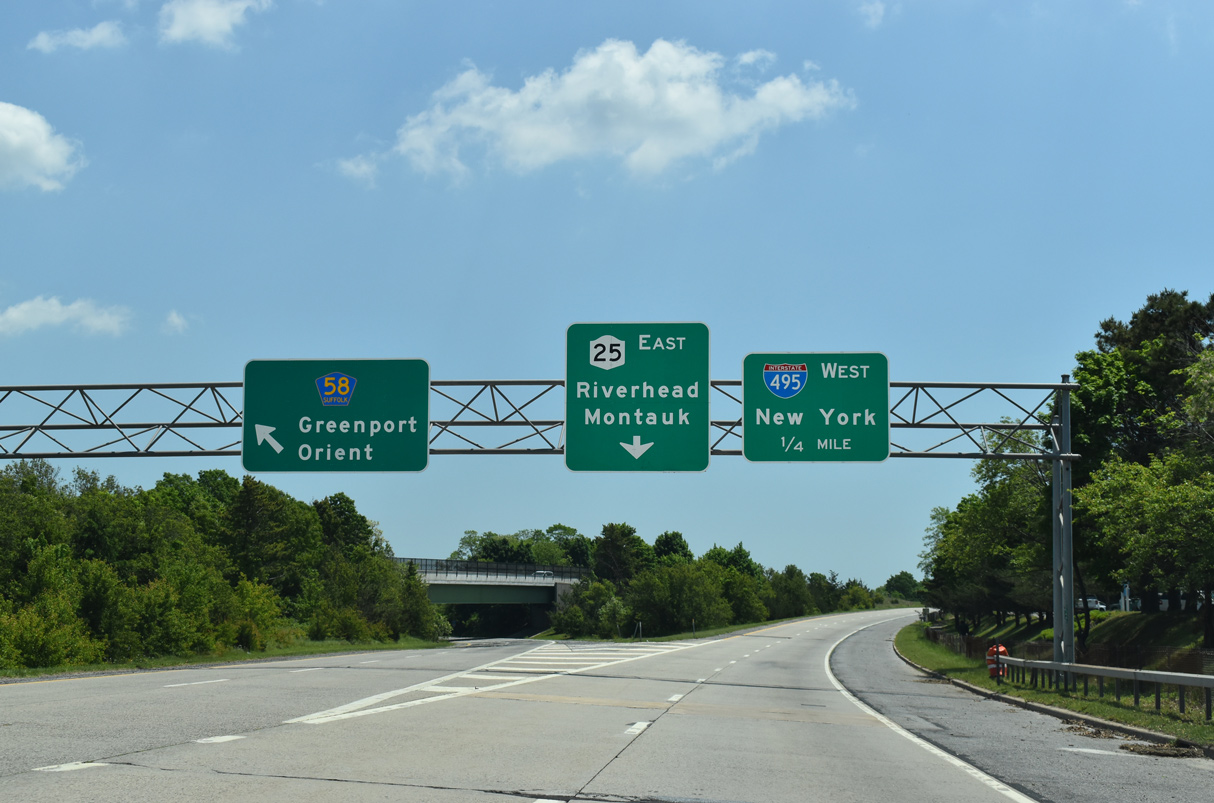
NY 25 shifts south onto River Road and Main Street from a wye interchange with CR 58 (Old County Road) leading into the half cloverleaf interchange with Interstate 495 west. 05/30/22

West End ‐ Queens-Midtown Tunnel – Astoria, Queens, NY
West at Queens-Midtown Tunnel
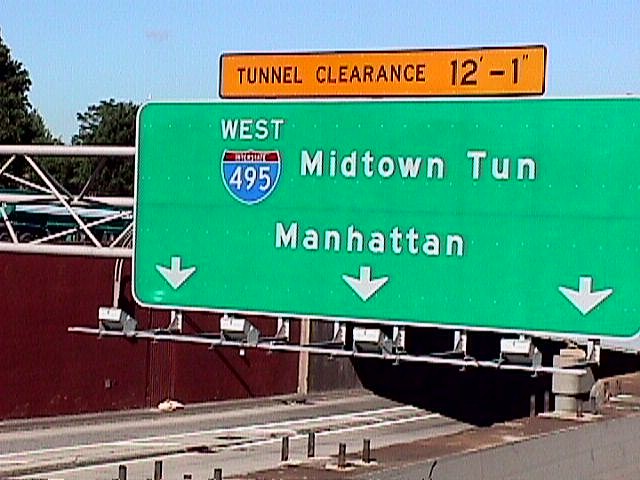
Interstate 495 leads west into the Queens-Midtown Tunnel, which connects with 34th and 39th Streets at Midtown Manhattan. Photo by Jim K. Georges (07/98).
FDR Drive north at E 34th St to
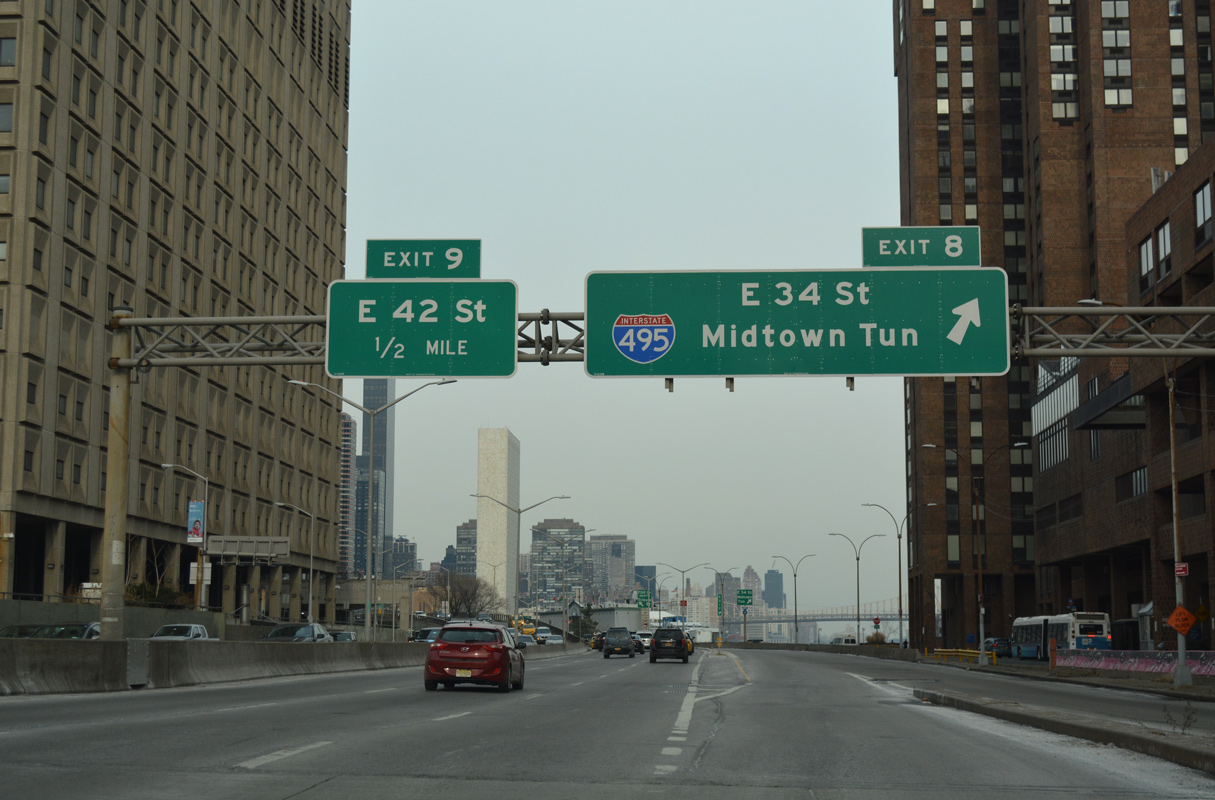
Exit 8 departs from FDR Drive north onto an adjacent service road to E 34th Street to the Queens-Midtown Tunnel (I-495). 12/17/17


E 34th St at Tunnel Approach St to
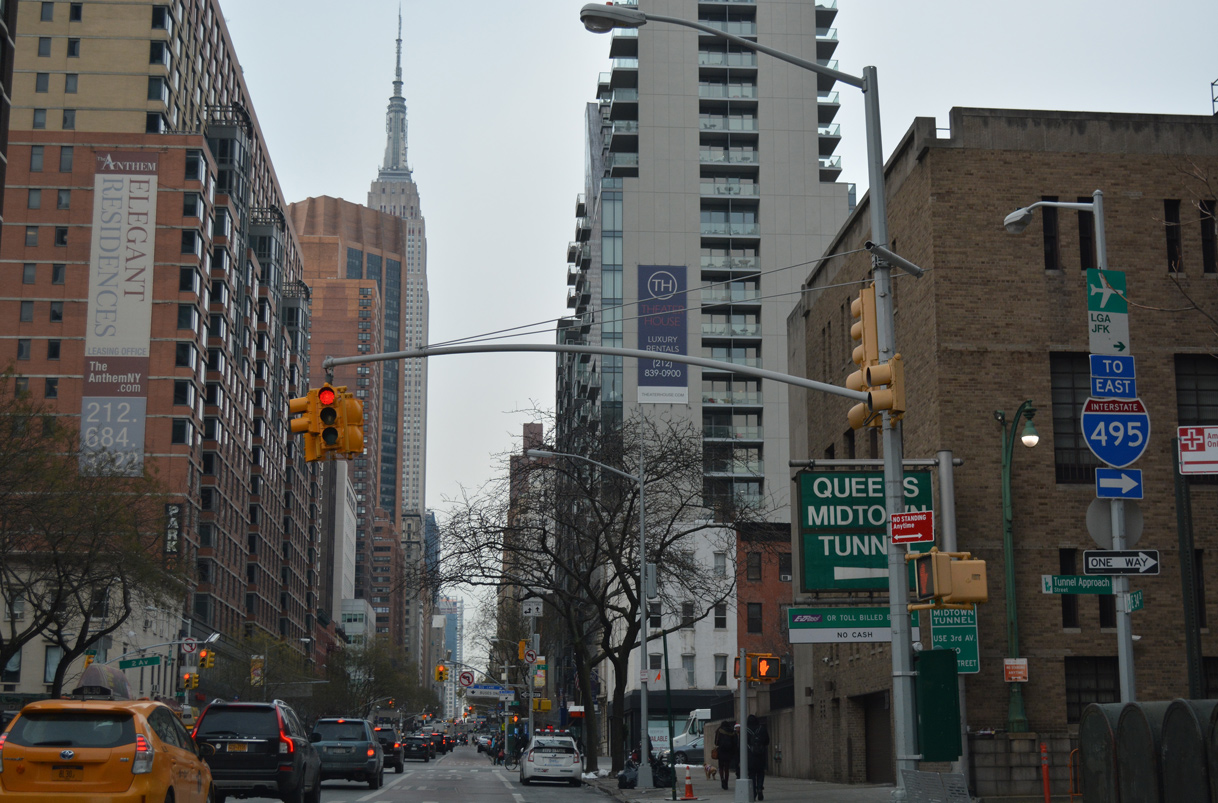
Tunnel Approach Street stems north from E 34th Street to the Queens-Midtown Tunnel beyond E 36th Street. The tolled tunnel crosses the East River to Long Island City and Hunters Point in Queens. 12/17/17


Queens-Midtown Tunnel – East
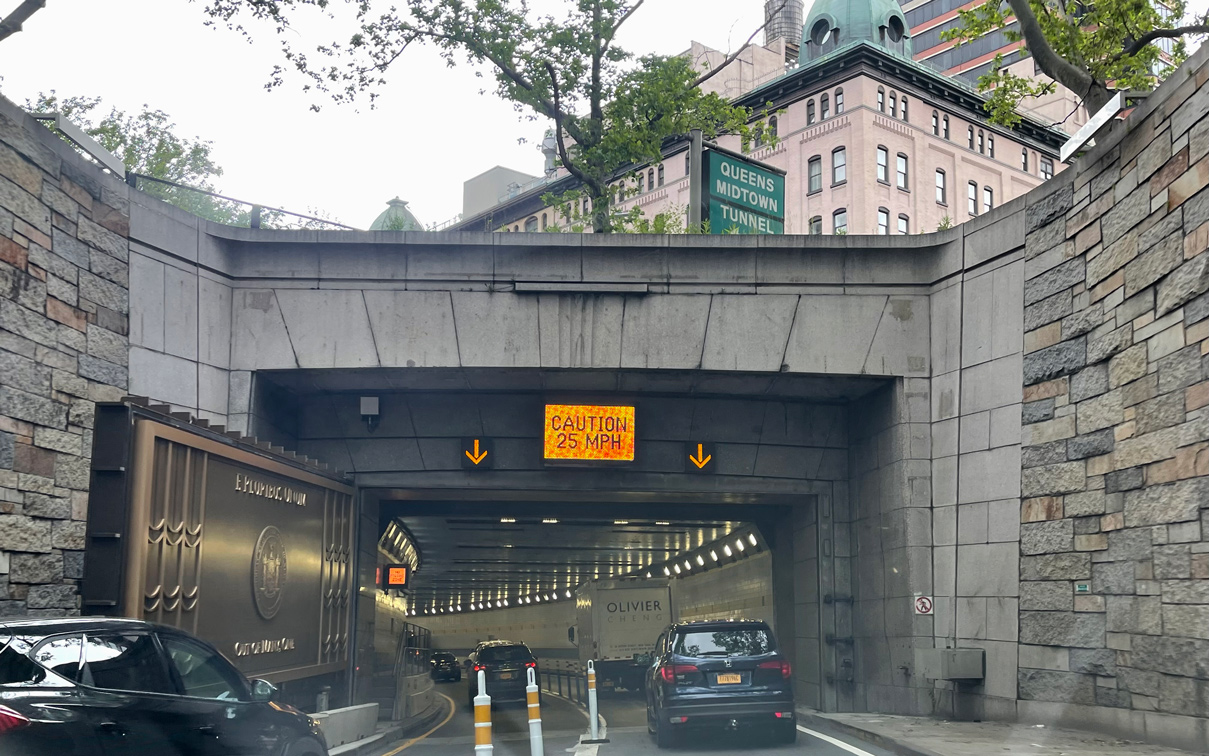
Traffic from 2nd Avenue, 36th Street and Tunnel Approach Street consolidates to two lanes leading into the Queens-Midtown Tunnel eastbound below 1st Avenue. Photo by Peter Johnson (06/12/21).
References
- New York State Department of Transportation (NYSDOT). Retrieved from https://www.dot.ny.gov/divisions/operating/oom/transportation-systems/repository/2012 tour-bk.pdf
- Federal Highway Administration (FHWA). The Dwight D. Eisenhower System of Interstate and Defense Highways. Part V - Interstate Withdrawal-Substitution Program. Retrieved from https://www.fhwa.dot.gov/highwayhistory/data/page05.cfm